Ryland Wittman
Tampa, FL | rylandscottwittman@gmail.com | (847) 714-3013
Objective
I build solutions by spotting flaws and finding better ways to fix them, diving into infrastructure as code, machine learning pipelines, and emerging tech like agentic AI. I thrive on learning through projects and want a team that values fresh ideas.
Skills
Programming: React, React Native, NodeJS, Python, SQL, Bash
Tools: Terraform, Docker, AWS, GCP, Cloud SQL, Self Hosting at scale, Redis, Git, FastAPI, Kafka
Strengths: Full Stack web design, IaC design, algorithmic data processing, adaptive problem-solving
Projects
These are things I tackled because I saw room for improvement.
React Native Mobile App
Leading a Native Code Developer Team in the Age of AI Coding
Abstract: 90% of the way through developing our frontend code, I became increasingly frustrated at the heaps of mismatched code dialects accumulating in the repository. Too many pull requests contained code with the personality of the AI coding assistant the developer used. Despite implementing clear policies and standardized guidelines early on, the bigger the codebase grew, the more diverse the LLM-assisted PRs became. Instead of addressing this issue by limiting the use of AI to a single provider, or by outlawing the use of AI all together, I took an approach that turned out to be massively beneficial for the team. I forked the repository and refactored the entire frontend to use a Feature-Sliced Design (FSD) architecture. Not only did this produce positive outcomes in the universal Interpretability of AI assisted coding, it also created a very intuitive architecture flow, thereby enabling easier onboarding. We also found that it became smoother for multiple developers working on adjacent code simultaneously, and the hierarchal architecture that inherently demands strict adherence became somewhat self-regulating.
Full Stack Architecture
CoPythonPro
Utilizing The Artificial Intelligence We Want On Our Team
Why I Built It: Social media's overrun with bots, and I realized those AI-generated accounts signal a bigger problem—attacks can scale so fast we need to be ten steps ahead, all hands on deck.
Abstract: Created CoPythonPro, a Python-based middleware to secure API ecosystems against rapid threats. Features AI-driven Data Loss Prevention with ML models to spot sensitive data, plus swarm intelligence for real-time coordination across nodes. Includes self-healing agents for uninterrupted service and adaptive rate limiting for high traffic. Scaled with a Kubernetes setup on AWS, using load balancers and auto-scaling groups for zero-downtime operation. With a few tricks up its sleeve.
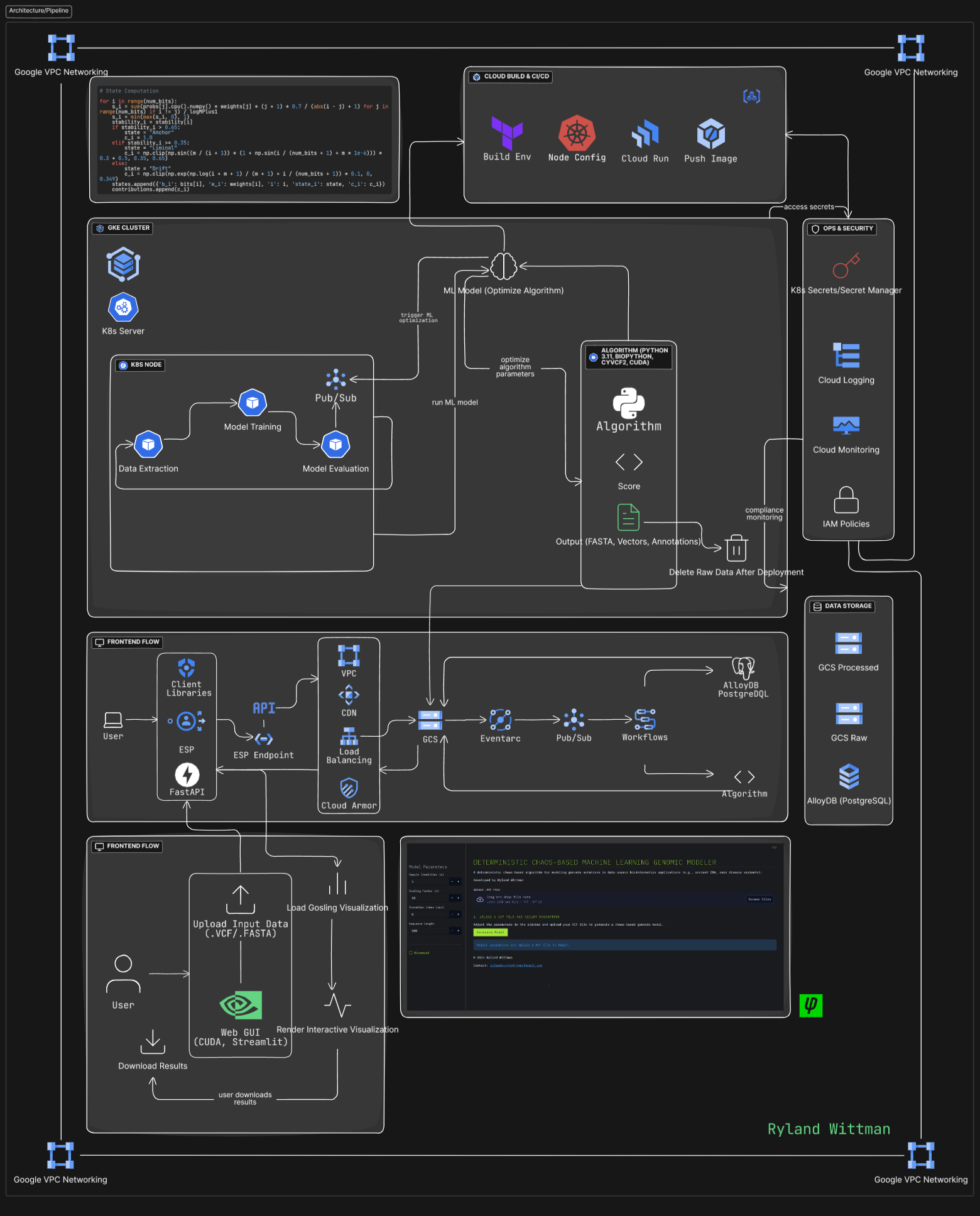
LiminalGenix
Why I Built It: I started rethinking how we approach problems, tracing back thousands of years to design a mathematical algorithm based on deterministic chaos-theory with three states. Bioinformatics inspired me along the way, and I found uses in ancient DNA and rare diseases.
Abstract: Developed a web-based GUI using Python 3.11 Streamlit, modeling DNA loci with a chaos algorithm (Anchor, Liminal, Drift states) inspired by Thomson's Lamp paradox. Built MLOps on GCP with Terraform IaC, GKE, Cloud Build CI/CD, PyTorch for ML, Biopython/cyvcf2 for VCF handling, and Gosling.js for visualization. Processes ClinVar VCFs to output FASTA sequences; tests show 48.70% variant overlap (12.30% pathogenic) on 1000 variants, reducing errors by 35% and compute by 20%. Containerized with CUDA 12.1 GPU support, with a roadmap for broader genomic applications.
Water Infrastructure Optimization
Why I Built It: Working in agriculture business operations, I saw water delivery systems struggling to meet demand. I wanted a design that could double the daily amount deliverable for vital operations.
Abstract: Built a water reserve quick-fill station system while working in agriculture business operations, analyzing existing infrastructure to identify inefficiencies. Focused on structural improvements to double water delivery capacity, with a design that lowers maintenance requirements.