004Independent Researcher
Constraint-Invariant Spatial Inference System
Frosty-compatible signal processing framework for detection and tracking under dispersive, anisotropic, and reference-limited Arctic propagation conditions.
Why I Built It
The Frosty program addresses the challenge of sensing in environments where the received electromagnetic field is strongly modified by turbulent, dispersive ionospheric propagation. In these conditions, assumptions fundamental to traditional radar and passive sensing — stable waveform structure, recoverable coherence, known polarization, or reliable reference signals — are frequently violated. This motivated an approach that treats dispersion and decorrelation not as errors to be inverted, but as unknown operators under which only certain physically grounded properties can remain invariant.
Abstract
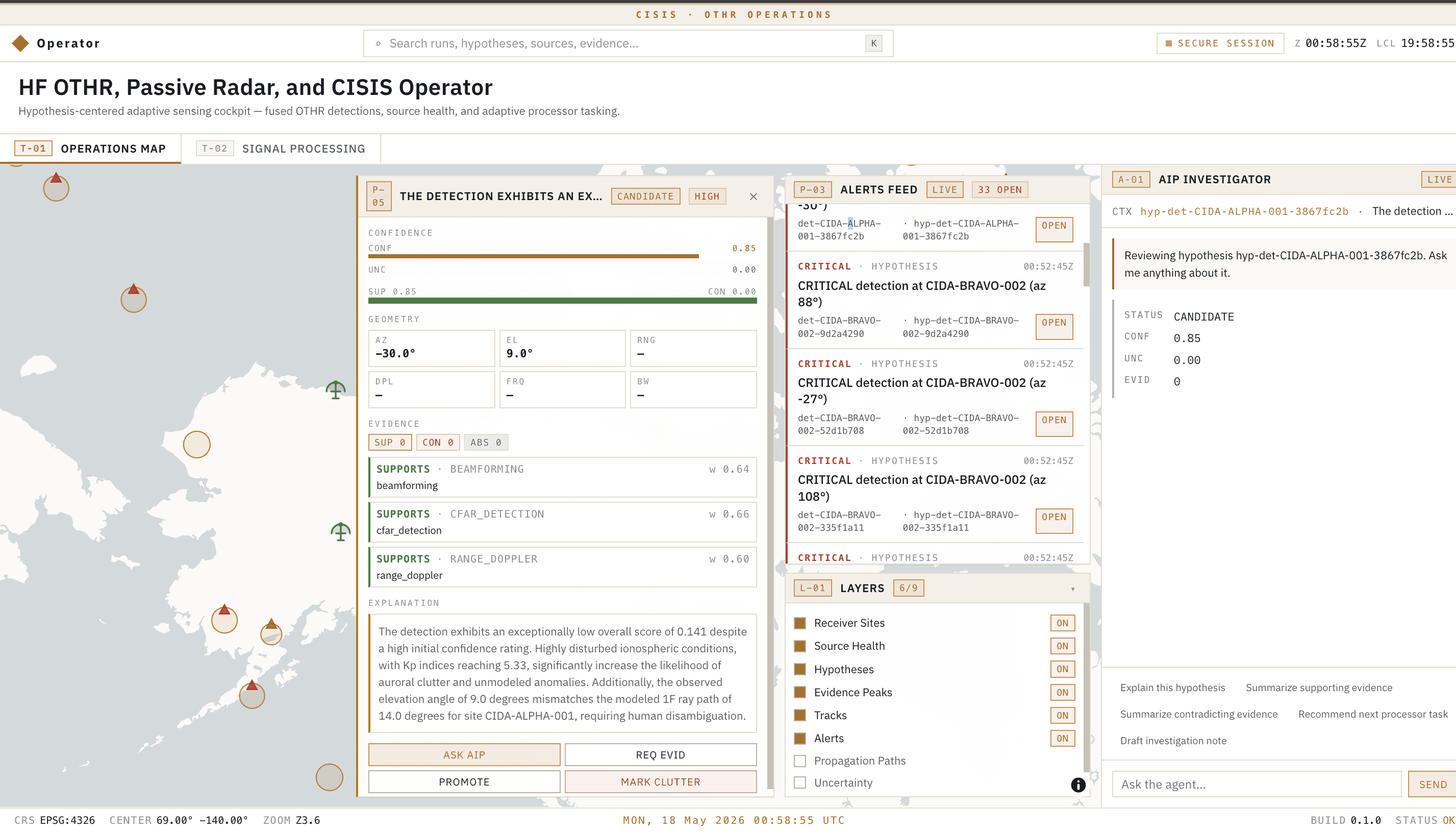
CISIS is a Frosty-compatible signal processing framework for detection and tracking under dispersive, anisotropic, and reference-limited Arctic propagation conditions. The goal is to identify and exploit properties of the physical environment that remain invariant in received electromagnetic field measurements, even as waveform structure, polarization, and propagation decorrelate.
CISIS operates directly on baseband I/Q measurements and does not rely on waveform coherence, reference–target correlation, or explicit channel inversion. By enforcing physically grounded spatial, temporal, and multi-site constraints, CISIS enables robust sensing in regimes where conventional radar and passive noise radar approaches fail, while remaining compatible with controlled noise-like illumination and endogenous ambient fields envisioned under Frosty.
Constraints
- Spatial Consistency
- Temporal Continuity
- Cross-Frequency Invariance
- Multi-Site Agreement
- Background Subspace Exclusion
- Reference Independence
Initial implementations use Python and NumPy with clear isolation of computationally intensive kernels — covariance accumulation, subspace estimation, spatial scoring, and path inference — to support a straightforward transition to C++/Rust or GPU acceleration.
002Gallery